Hobby Essentials for Beginners: What You Actually Need
The essential is not the largest kit. It is the smallest thing that makes a real first session possible. Choose a direction, name the blocker and set a budget ceiling. You will get three starter paths and a no-buy test before any shopping guide appears.
A beginner essential should remove one proven blocker, not create a bigger pile of unused supplies.01Name the directionMake, grow or move02Prove the blockerInstruction, access or one basic03Open one guideOnly after a finished test
The direct answer
Most hobby essentials are access, instruction and a finish line
A beginner usually needs a clear first task, basic guidance, a suitable place and the minimum material required to finish. Optional colors, storage, upgrades and large bundles can wait. If you can complete a useful test with what you own, can borrow or can access publicly, you do not have a purchasing blocker yet.
EssentialWithout it, the first session cannot happenOptionalIt adds variety but does not unlock the startProofOne finished attempt identifies the real gapCeilingSet a small limit before comparing choices
3 questions · 27 states
Find the smallest starter path that can prove the hobby
Every combination ranks the same twelve no-buy paths. Product availability, price and commission never affect the order.
Your three essentials paths are ready.
No-buy proof test
Prove the need before buying
Did this earn a second session?
12 crawlable starter paths
What is actually essential for twelve beginner hobbies
The minimum varies by hobby. Each path below begins with a free, household, borrowed or public version and names a finish line before supplies.
Make with ordinary materials
Pencil sketch - one pencil, scrap paper and a five-object contour exercise.
Paper fold - one square of reused paper and a free diagram for a single form.
One-page journal - any pen, one page and three prompts with a stopping point.
Puzzle sprint - a borrowed puzzle, library puzzle or free printed logic sheet.
Learn one material
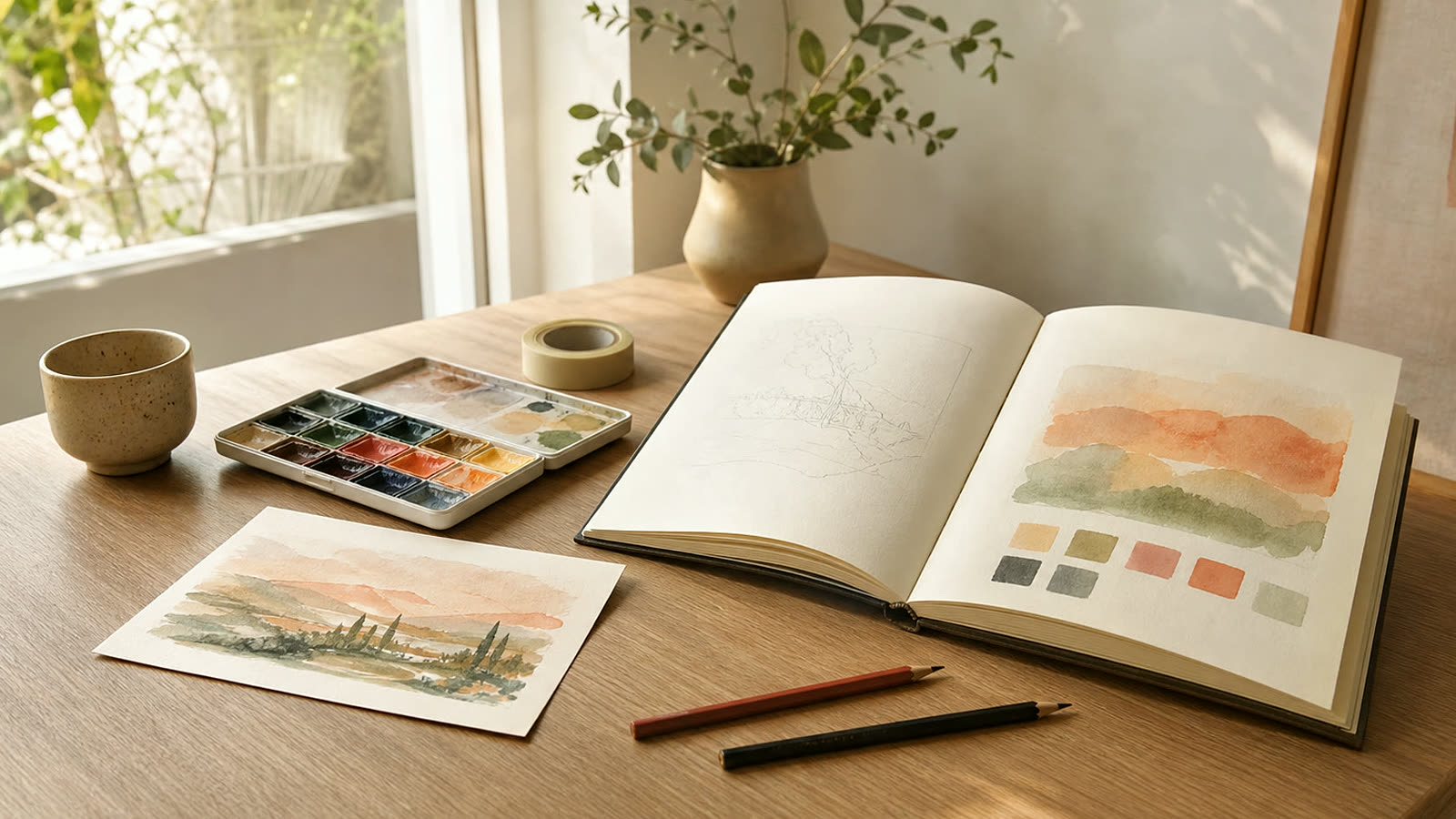
Watercolor swatch - borrowed paint, one brush and paper that can tolerate water.
Crochet chain - borrowed hook and yarn plus one beginner lesson.
Clay pinch bowl - a small borrowed or low-cost air-dry clay portion and a protected surface.
Grow and observe
Herb cutting check - one suitable cutting or seed, a reused container and a measured light spot.
Bird list - a public window, yard or route and a free identification reference.
Phone photo walk - the phone you own and a five-frame pattern assignment.
Move and play
Neighborhood walking loop - a familiar safe route, suitable shoes and a turnaround point.
Pickleball wall drill - a permitted wall or court and borrowed paddle and ball access.
Hobby essentials FAQs
What are the essentials for starting a hobby?
A clear first task, a finish line, basic guidance and access to the minimum material or place. Large kits, upgrades and variety packs are usually optional before the first completed session.
Should a beginner buy a starter kit?
Only when a completed no-buy or borrowed test reveals a specific missing basic and the kit contents match that need.
How much should I spend?
Begin at zero when possible. If a second session earns a purchase, set a small ceiling before comparing and ignore extras that do not solve the blocker.
How LikeHobby separates essentials from extras
The matcher scores twelve fixed starter paths by direction, current blocker and spending ceiling. It returns exactly three routes for every state. Product availability, price and commission do not influence the ranking.
01
Access before ownership
Borrowed, household and public options can prove the hobby without a purchase.
02
Finish before comparison
A completed task exposes the actual instruction, place or tool gap.
03
One guide after proof
Only a repeat signal reveals one relevant first-party guide.